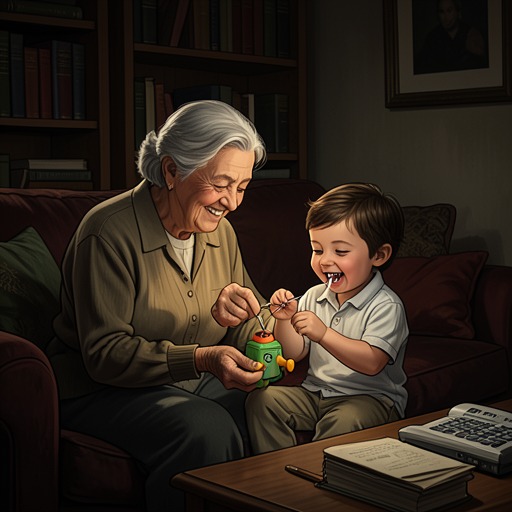
Sophia and Grandmother’s grandparent-grandchild relationship
The Summer BookSophia and Grandmother’s grandparent-grandchild relationship is the emotional center of The Summer Book. It is made less through declarations than through shared days on a small island: exploring, making things, arguing, and staying close when fear or frailty intrudes. Their bond is affectionate but not sentimental. Grandmother treats Sophia as a person capable of judgment and courage, while Sophia’s care for her is expressed in practical attention, blunt questions, and a child’s refusal to accept that age must mean helplessness.
Companions in the island’s daily life
From spring onward, the two move through the island together, their companionship giving shape to the long, slow months before autumn. They make animal sculptures and bark boats, collect berries, driftwood, and bones, draw “awful things,” build Venice in a marsh pool, row to other islands, swim, sleep, and talk. Their activities range from imaginative play to ordinary work; the island becomes a place they make and interpret together rather than merely inhabit. Grandmother’s participation is not simply supervision. She shares Sophia’s projects and lets the child’s inventions set the terms of a day.
Their conversations give that everyday closeness unusual breadth. Sophia can ask whether there are ants in Heaven and when Grandmother will die. Grandmother answers her question directly: “Soon. But that is not the least concern of yours.” The reply acknowledges mortality without turning it into a lesson or asking Sophia to comfort her. Their openness about death sits beside play and practical routines, making difficult subjects part of their shared life rather than an interruption to it.
Trust, risk, and a private language
Their closeness includes room for risk and mischief. When Grandmother’s walking stick rolls into a pool as Sophia climbs a high channel marker, Grandmother understands that shouting might startle the child. She watches and encourages her instead. The marker’s widely spaced white planks and red triangle make the climb slow and frightening; Sophia pauses between steps while Grandmother waits for her to come down safely. Afterward, Sophia wades into the pool to retrieve the stick. Grandmother praises her nerve but raises the possibility of telling her father. Sophia shrugs and suggests that the story can wait until Grandmother’s deathbed. Grandmother accepts the joke as a good idea. Their exchange turns a dangerous moment into a shared secret, preserving both Sophia’s pride and their trust.
The same intimacy lets them challenge one another. When Grandmother reflects that age has made enjoyable things seem to recede and that she can no longer remember what sleeping in a tent felt like, Sophia rejects the implication that Grandmother has stopped doing things. Grandmother insists that she has lived intensely and done everything she could, but now feels memory and interest slipping away precisely when she needs them. She recalls helping win the right for girls in Sweden to sleep outdoors, and the frustration of being unable to recover the experience clearly. Sophia answers not with consolation but with a description grounded in her own tent night: the small space, the sharpened sounds outside, and the feeling of safety. Grandmother recognizes the value of that account. The scene lets Sophia offer something her older companion cannot supply alone: a present-tense memory of the experience they both care about.
Shared care and changing roles
Care passes between them rather than flowing in only one direction. Grandmother is old, with weak legs and a dizzy head, yet remains lively in imagination and judgment. Sophia, meanwhile, can be anxious and in need of protection. When Sophia becomes suddenly afraid of small animals, creatures she had once trapped, tended, and eventually released, Grandmother tries to discuss the fear even though she cannot talk it away. After Sophia cuts an angleworm in two with a spade and screams at its writhing halves, Grandmother proposes a way to continue: Sophia can dictate a book about the worms while Grandmother writes. The imagined title, A Study of Angleworms That Have Come Apart, turns terror into a project they can undertake together. Grandmother finds her glasses and opens a page already illustrated with the divided worm; Sophia reads aloud while her father works on the other side of the wall. Their collaboration does not erase the fear, but gives Sophia company and a form for attending to it.
Sophia’s concern also appears in her treatment of a much smaller and more timid visitor, Pipsan. Sophia decides to protect her and proposes a secret society; Grandmother contributes the private name Berenice, after a queen known for her hair and a constellation. Because Pipsan cannot be left alone, Sophia stays close and is always in a hurry. This episode reflects the care she receives from Grandmother without making the two relationships identical: Sophia now assumes a protective role herself, while Grandmother helps her give that impulse a playful shape. Grandmother also understands how exposed an outsider can feel in the island’s established world, where familiar people and routines close ranks around what they know. Her awareness gives their companionship a quiet social dimension: they can make a place for someone vulnerable because they know what it means to be responsible for another person’s ease.
Aging, autonomy, and mutual recognition
Their relationship does not hide the constraints of age. On a night when the guest room is cold, Grandmother wakes at three, puts on her clothes, takes her walking stick, and goes outside to hear the long-tailed ducks. Later, her weak legs and dizziness are part of the contrast between her physical vulnerability and her alertness to the island, its birds, and its changing seasons. Sophia is not merely protected from these facts: she asks about death, notices what Grandmother can still do, and responds to her grief over lost memory. Grandmother, in turn, takes Sophia’s fears seriously without pretending that every fear can be reasoned away.
The distinction between assistance and control matters to their bond. In another conversation, Grandmother speaks with Verner about the difficulty older people face when others assume responsibility for them; she recognizes how consideration can leave an older person feeling in the way. That wider concern sharpens the meaning of her own companionship with Sophia. She does not reduce herself to a dependent or Sophia to a caretaker. Their shared decisions, jokes, work, and disagreements preserve Grandmother’s agency while allowing Sophia genuine responsibility. The relationship is therefore neither a simple reversal of adult and child nor a denial of their difference in age: it is a flexible exchange in which each can be knowledgeable, vulnerable, and useful.
Narrative significance
The book’s sequence of summer episodes gives their relationship continuity without making it depend on a single dramatic resolution. Repeated practices—rowing, sleeping, talking, making things—accumulate into a shared history, while frank exchanges about death, bodily limits, fear, and memory keep that history open to change. Grandmother offers experience and perspective; Sophia brings present-tense curiosity and the conviction that their common activities still matter. Their exchanges make mortality and aging intimate subjects, not abstractions: the deathbed joke can coexist with the real possibility of loss, and a remembered campaign for girls’ freedom to camp can meet a child’s fresh account of what a tent feels like.
Their significance lies in this mutual recognition. Grandmother does not ask Sophia to stop being a child in order to understand her, and Sophia does not treat Grandmother’s age as the whole of her identity. They inhabit the same island while experiencing it differently, and their companionship lets those differences meet in practical acts, teasing, stories, and attentive listening. The result is a bond that is tender precisely because it remains unsentimental: affection takes the form of making room for the other’s fear, judgment, humor, and changing capacities.